Halley's comet returns, 1909–1910
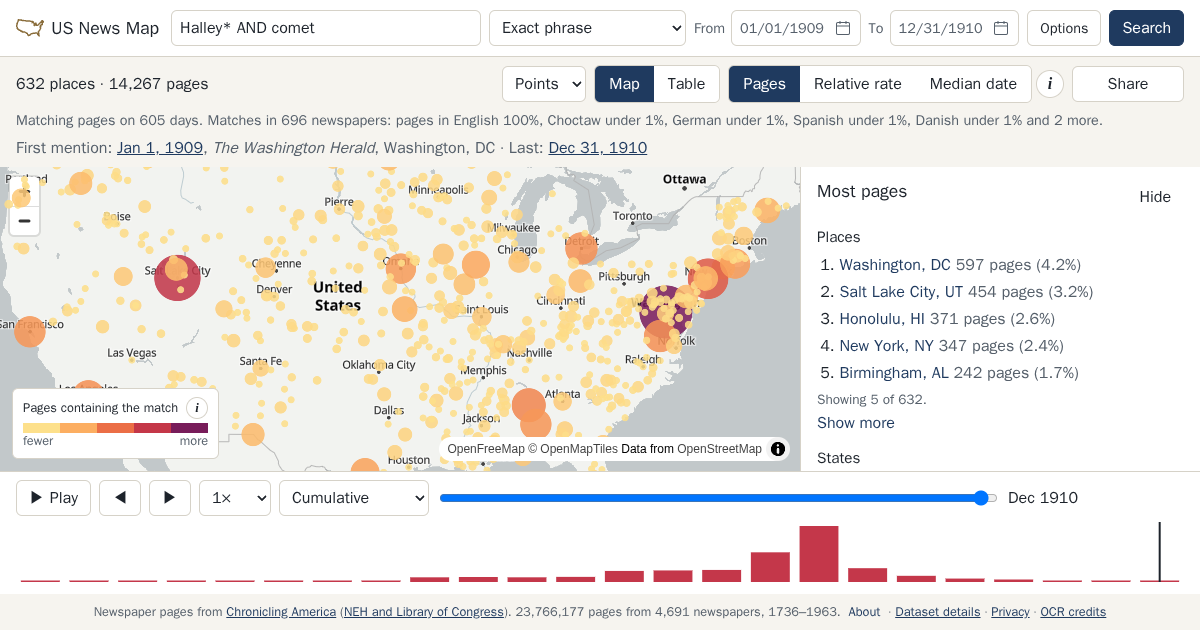
The comet's 1910 return inspired observations, publicity, and public anxiety. Newspaper pages from 1909 to 1910 on a map and timeline.
US News Map searches Chronicling America, the Library of Congress collection of digitized American newspapers, and maps every matching page by where and when it was printed. Play the timeline to watch a word or a story move across the country.
Each result links to the full page image at the Library of Congress. US News Map is maintained by Trevor Goodyear.
23,766,177 pages from 4,691 newspapers, 1736–1963.
Sample results
14267 matching newspaper pages in total. Washington, DC has the most hits (597 pages). Showing up to 10 earliest results from this city.
The Washington Herald — 1909-01-01, page 7
… interest to the astronomer. There are four eclipses scheduled to take place, two of the sun and twe of the moon. Saturn is beginning to spread his rings, the sunspots on the face of old Sol will reach their lowest ebb in im portance and numbers, Halley's comel will again return to mortai vision, and other lesser events in the solar system will ceccur. Before next December's sun is set the star gazers of the world may have many things to add to the book of human knowledge. The government …
… eclipses of the sun will not be as fuil of interest as some others have been, and the second one, occurring in December, will go unobserv ed, at least so far as American asirono ners are concerned. 3 Br =a ca i oe y eu] ee _ i i i The coming of Halley's comet will be the astronomical event of the heavens of 1909. For thirty-eight vears it has been traveling toward us at the rate of 2,246.000 miles every day, and is now about 450,000, 000 miles away. By the middle of May, 1919, it is expected to …
… trotting seems to put the stains of travel upon it. The Astronomical and Astrophysical So ciety of America has appointed a commit tee of four astronomers to outline ways and means for studying this celestial visitor. The con et bears the name of Halley, because it was he who predicted its return, stating that he would be dead when it came. but that he wanted poster ity to remember his prediction. al i a _— 3 Tha coming of this comet will bring heavy meteoric showers with it, and the world may oxpect to see some brilliant Jisplays of shooting stars. It is said that {liere are 00,000,000 meteors hurled in our direction every vear, and that if it wers not fer the atmospheric …
Evening Star — 1909-01-07, page 6
… politics and the present condition, in which parties must ap 1 io prui lur Duppun un ^ruercti piiuupico, 10 the difference between an age of barbarism and an age of enlightenment. Boom Times in the Skies. From the Pittsburg Dispatch. With one comet here, Halley's comet to come and a new planet about to make Its debut, things astronomical for 1901) promise to be decidedly interesting. The Administrative Arch. From the Philadelphia Press. Having got the keystone of his cabinet, the rest ougltf. to be easy …
Evening Star — 1909-01-16, page 18
… what's the matter with 'em?' asked the interviewer. goula. Miss., for an appropriation by Con- ; Kress to indemnify him for the loss of his < title to a part of Round Island and to < thereby enable him to collect a aeries of photographs of Halley's comet taken t during 1909 and 1910 and observe that t comet's return to perihilion In 1910. 1 "Your undersigned petitioner, a loyal 1 citizen of the United States, an humble ? amateur observer of current astronomical 1 events, formerly, during the 7th decade of last century, a land and colonization …
… Pascagonla and of < all his work and expense Incurred in pro- < curing a confirmation of the title to said island by Congress, thereby relieving his 1 present financial straights and enable him 1 to collect a series of photographs of Hal- 1 ley's comet obtained in this country and < abroad during the years 1908. 1909 and 1910. and observe its course during the I period of its visibility to the naked eye ] in 1910. ."Your petitioner, whose self-acquired J knowledge of astronomy and means …
… of in- ' formation are very limited, is especially 1 interested in the impending return of that 1 comet, because, according to his mother's ( story, one early morning in October, 1KH.1, 1 when a ten-month-old baby in his' mother's arms, she was greatly frightened Kvr a en^Hon imAYnAftpfl siaht of that ' Wj ?* HUV.UVI* ULVrt^VVVM ?U"V ??. ? comet, Just rising over the roof of his native place at Armstadt, Germany. Aft- ( erwrards, his mother often told him tnat his baby eyes noticed it also and that he nearly jumped out of her arms trying to ] reach up for it and catch it with his …
Evening Star — 1909-01-27, page 11
… cantains. IS tirst and .'Mi second lienten- I mts. The enlisted force of the corps is ncreased from 1,200 to *-1,000. These in- j ureases are practically those requested by | :he Secretary of War. THE HEAVENS IN 1909. Eclipses of the Sun and Moon?Halley's Comet Visible. Astronomical phenomena in 1909 will be if sufficient interest to give tlie student >f this branen of science something to ook forward to. There will be a total jclipse of the moon on June and it will ie visible generally in Europe …
… south polar regions and parts of Australia, New Zealand and the South Shetland Islands. There are two periodic comets due in L909, and one which is due at perihelion inly early in 1010 may be caught sight >f in the latter part of this year. Comet C. 1008 (Morehousei, which will >oon be invisible to us in the northern lemisphere. will be plain to observers in South America, and will afford a splendid ipportunity for a series of photographs which will be unique in tlie history of :omets …
… . After May, 1900. it will be again "isible to northern observers. The astronomical world is looking forward to Halley's comet this year, though its perihelion may not be reached until May, 1910, but will undoubtedly be seen n the autumn in 1909. This celestial visitor is to be. perhaps, he most important autumnal phenomena i >f the year, from its long history and …
Evening Star — 1909-01-30, page 22
… typewriter t ?ho, ho. ho!?don't make me make a noise like nineteen coyotes. It hurts my e hangnail. You learn how to run it, hey? J Ho, ho. ho! Great! Gur-r-reat! Gur-r-reat- i est ever! Say, you could Just about as / easily learn how to search for Halley's t comet with a piece of smoked glass as i you could learn how to operate this or a any other typewriter. Not that it's a o hard typewriter to operate?nunno nunno! 'I Any little prattling child could learn to c m^m, . . , ."r V^r-n.Y' " >arade. It …
The Washington Herald — 1909-02-17, page 6
… did not give over until the early summer. His speaking campaign was a marvel of en durance, and since his election he has been the same consistent laborer. The strenuous life is not one that is lived alone by Theodore Roosevelt, LOOKING FOR HALLEY'S COMET. Astronomers the World Over Await Advent of This Heavenly Body. From the Londen Globe. Astronomers all the world over are eagerly awaiting the advent of Halley's comet, which will be a beautiful object in the sky during the spring and summer of 1810. The history of this domet forms one of the romantic chapters jn the rec ords of astronomy, and is insperably connected with the name of Edmund Hai ley, who …
… occupies a foremost place among the great English astronomers of the past. The great comet of 1882, says the Uni versity Recorder, engaged Halley's atten tion for several years. He collected the records of various conspicuous comets which had previously been observed, and was struck by certain resemblances in ap pearance and rate of motion between the 1652 comet and a comet seen in 197. An other record, by Appian, of a fine comet in 1521, led Haliey in 1705 to the coaciu sion that these were three successive ap pearances of one and the same comet and that this body is a member of the solar system, moving {like a planet) along an elliptical path round the sun once in about seventy-six years, but in an oppe site direction to that of the planets and with a large orbit of much greater …
… ec centric. ee He predicted that the comet would next appear in 1357 or Ii8. It actually ap Lo en Christmas Day, 1388, and was closest to the sun on March 12, 1358. Hal ley’s comet appeared last in 1825 and was carefully observed by Sir John Her schell As it approached the sun its long spreading tail, as well as its head (coma), diminished in size, and the comet was less brilliant than in 1758. It is now well established that comets lose part of their substance at every approach to the sun. owing to thelr throwing out long tails, and in the case of short-period com et2 the time of perihelion (i. e …
Evening Star — 1909-02-20, page 24
… you've got hold of a puzzle that can't be done, hey?" said Mr. Jobson, facetiously, after a pause. "Just because you can't do it. why, of course it can't be done. I s'pose, on the same principle, you'd swear that because you couldn't find Halley's comet with the naked eye there isn't any such a tiling as Halley's comet? Gorgeous reasoning powers you possess. Just beca use you never saw one of those half-zc ra, half-horse things called okapis. I s'pose there Isn't any such an animal, hey?" "I wouldn't go quite so far as that." replied Mrs. Jobson, soothingly …
Evening Star — 1909-04-25, page 56
… the delicate lit tle northern crown, and the large but less striking group Hercules, with its wonderful star cluster at C, Fig. 1. To Kiipirf 2. The motion of the nan and Yenui during May and the position of Mercury on May 20. foprching for Halley's Comet?Favorable Time for Viewing the Swiftly Moving Planet Mercury. By Professor Eric Doolittle of the University of Pennsylvania. FlRnre 1. The Constellation* at p. m. Mar 1* the early Arabians the region of the sky bordered by the stars marked …
… which shines out near the cen ter of the constellation Ijeo, Just above the star at R, Pig. t. This planet re quires twelve years to complete the cir cuit of the heavens in Its slow eastward journey among the stars. For many T Figure i The comet ef 1843. Figure 3. An early KprnenUtioB of Halley's comet from the Bayeani tap estry. weeks*it lias been moving westward, but on May 1, at 7 p.m., it becomes station ary and then begins to move eastward again. Though its motion is so slow, the observer can readily detect it by noticing the position …
… it will apear as a half moon, while Venus, on the contrary, is now nearly round. After reaching the point E, Mercury will move swiftly backward toward the sun. passing Venus on June 7, at which time the two planets will betwo degrees apart. Halley's Comet. The most celebrated comet is sttll be ing systematically searched for by as tronomers. who expose delicate photo graphic plates to the region of the sky in which it is known that It will first makelts appearance, but up to this date it has not been detected. Figure …
The Washington Herald — 1909-05-06, page 6
… something of a vokel issue. The Augusta Herald informs us that some one inadvertently picked up “Lit tie Joe” Brown's hat the other day and walked away wearing it. A whole lot of people would like to be in “Little Joe's” shoes we suspect. Since Halley's comet is scheduled to hit the United States amidships sooner or later, Congress should look into the matter of a tariff on comets. We can not have foreign satellites and things coming into competition with home prod mote “Women who wear tight shoes …
The Washington Herald — 1909-05-07, page 11
… little story of the good cheer that prevails among the seekers for health in Colorado, Arizona, and elsewhere. Mr. Fitch, in this number, has another one of his poems, and several short stories, especially one on “The High School Graduate.” Halley's comet, known as the “Star of Bethlehem,” is rushing toward the earth at a terrific speed, and next Mav will present a grand sight in the heavens. This is the strange wanderer in the sky that astronomers predict will some day either annihilate the …
The interactive map and full results require JavaScript.