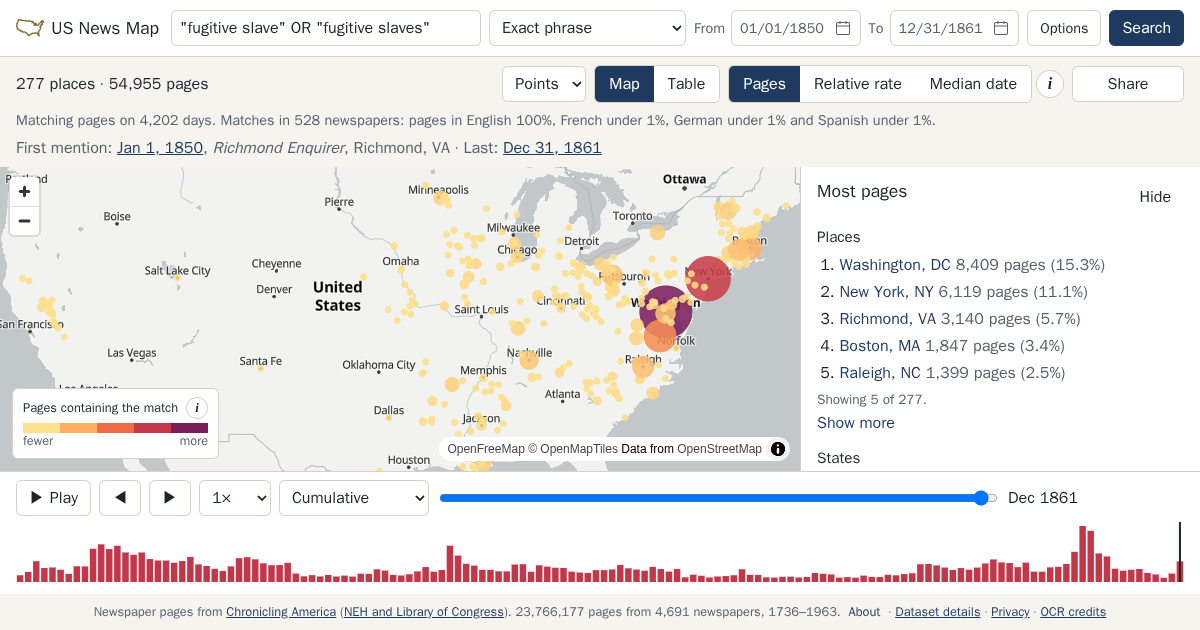
Fugitive Slave Act in newspapers, 1850–1861
The 1850 law, part of the Compromise of 1850, and the cases it brought. Newspaper pages from 1850 to 1861 on a map and timeline.
US News Map searches Chronicling America, the Library of Congress collection of digitized American newspapers, and maps every matching page by where and when it was printed. Play the timeline to watch a word or a story move across the country.
Each result links to the full page image at the Library of Congress. US News Map is maintained by Trevor Goodyear.
23,766,177 pages from 4,691 newspapers, 1736–1963.
Sample results
54955 matching newspaper pages in total. Washington, DC has the most hits (8409 pages). Showing up to 10 earliest results from this city.
The Daily Union — 1850-01-04, page 1
The Library of Congress text does not contain the match. It was found in American Stories (Dell et al. 2023), a second machine reading of the scans. OCR credits.
These excerpts come from American Stories OCR.
… the conflicting interests Of the States which formed III and in no part instrument y 20 be the subject Of slavery, excepting some special provisions having IN view the prospective sboltoa OF the African slave trade and for the recovery Of fugitive slaves Any he sasi.c % ss 70 asc, me ,S.aioa Of slavery il the Sates the District Of Columbia or In the Tcorics h g say the east violation Of the principle upon which that That ths nrntories acquired BY the blood and treas OF the whole nation ought …
The Daily Union — 1850-01-04, page 3
… were fully stated in our editorial introductory, with the excep tion of the statement in reference to the compromise of tbe constitution by which the people of the slave States were permitted to pursue into the free States and recapture their fugitive slaves. Those matters were stated in the paper alluded to as preliminary explana tions to the position of non-intervention which we as sumed?which we believe calculated to save our country and our institutions from an agitation which may (bat we …
… Massachusetts and other free States of the North.' Have not their legisla ture* passed law* denouncing severe penalties against those who shall assist in recovering runaway slaves > Did not Mr. Seward, when governor of New York, refuse to deliver up fugitive slaves.' Was not a citizen of Maryland murdered recently in Pennsylvania for pur suing and attempting to bring back a fugitive slave, the murderers being afterwards acquitted t We believe such things have occurred, and that in many of the northern Stataa it is impossibls for a master to recover his slave. do not say it is so in all tbe free States; but we think it is trne …
Daily National Intelligencer — 1850-01-04, page 1
… part at that instrument is to be found any delegation of power to Congress to legislate on the subject of slave ry exerpting some special provisions having in view the prospective abolition of the African slave trade, and for the recovery of fugitive slaves Any attempt, therefore, on the gress, to legislate on the suljeet so as to affect the part of C institution of slavery in the States, in the District of Colum bia, or in the Territories, is, to say the least, a violation of the principle upon …
The Daily Union — 1850-01-05, page 3
… that he is evidently incapable of admin istering his department with economy, prudence, and suc cess. Correction ? In our leading editorial yesterday, we stated that the Hon. William H. Seward, when governor of New York, refused to deliver up fugitive slaves escaping from their masters. _ We understand that we are mistaken in the statement which we made in our aiticle in reference to this matter. Mr. Seward did not refuse to deliver up fugitive slaves, bat he did, while governor of New York, refuse to deliver up persons indicted for stealing slaves in Virginia and Georgia. The substance of our state ment is not, however, affected by this correction. We copy the following article from the …
The Republic — 1850-01-05, page 2
… the more effectual execution of the third clause of the second section of the fourth article of the Constitution of the United States. Mr. CLAY asked that the bill might be read. It was read, and provides additional means for the recovery of fugitive slaves. The bill was then referred to the Committee on the Judiciary. By Mr. DICKINSON: A bill to establish a branch mint of the United States in the city of New York. Mr. D. moved its reference to the Committee on Finance. Mr. BENTON acknowledged …
Weekly National Intelligencer — 1850-01-05, page 3
The Library of Congress text does not contain the match. It was found in American Stories (Dell et al. 2023), a second machine reading of the scans. OCR credits.
These excerpts come from American Stories OCR.
… They p.o,d h, he General assembly Of The .Stae Of alsss1i, Isl, That the Federal Constitution the result OF com promise between the e % aaad aeH delegation of Congress to gsae on the OF excepting special hass a IN ysw few tine recovery Of fugitive slaves. Any attempt therefore, on the part of Congress- egate the subject so as to affect the institution OF slavery the States in the District OF Coambia or in Territories the least asoation Oft principle upon which that instrument was fouaded Cd …
The National Era — 1850-01-10, page 3
… liutler of South Carolina. Chairman of the Judiciary Committee, at the last session of Congress, providing that deputy postmasters, custom-house officers, aud other United States officers, be required to net in the recapture and delivery of fugitive slaves. Very honorable employment! Mr. Mason had the assurance to take for granted that the hill would meet with no , resistance. We take for granted that it may p iss the Senate?for we know not what that body will not do in its obsequiousness to …
Daily National Intelligencer — 1850-01-12, page 2
… universal habit. it is written in the constitution of the United States that five slaves shall count equal to three freemen as a basis of representation and it is written, also, in violation ofi the Divine law, that we shall surrender the fugitive slave who takes a refuge at our firesides from his relentless pursuer. as You blush net at these things, because they have become familiar as household words. What, then, you say can nothing be done for freedom because the public suit nee is inert …
Weekly National Intelligencer — 1850-01-12, page 4
… habit. * * * * It is written in the constitution of the United States that live slaves shall count equal to three freemen as a busts of representation ; and it is written, also, in violation of {fie Jhvine law, that we shall surrender the fugitive slave who takes a refuge at our firesides from his relentless pursuer. You blush net at these things, because they have become as familiar ai household words. ? * * ? What, then, you say ; can nothing be done for treedom because the public con science …
The Republic — 1850-01-15, page 3
… Committee of ri Ways and Means. . Also, the petition of John S. Mann and twenty . others, citizens of the couuty of Potter, Pemisylva- a nia, praying Congress u? repeal so much of the act of 12th February, 1793, as relates to the returu of fugitive slaves. Referred to the Committee on the Judiciary. Hy Mr. SCHERMERHORN The petition of the u citizens of tin- rity of Rochester, praying for the rl establishment of a scud monthly mail froin the city )' of New Tork to San Francisco. " The petition …
The interactive map and full results require JavaScript.