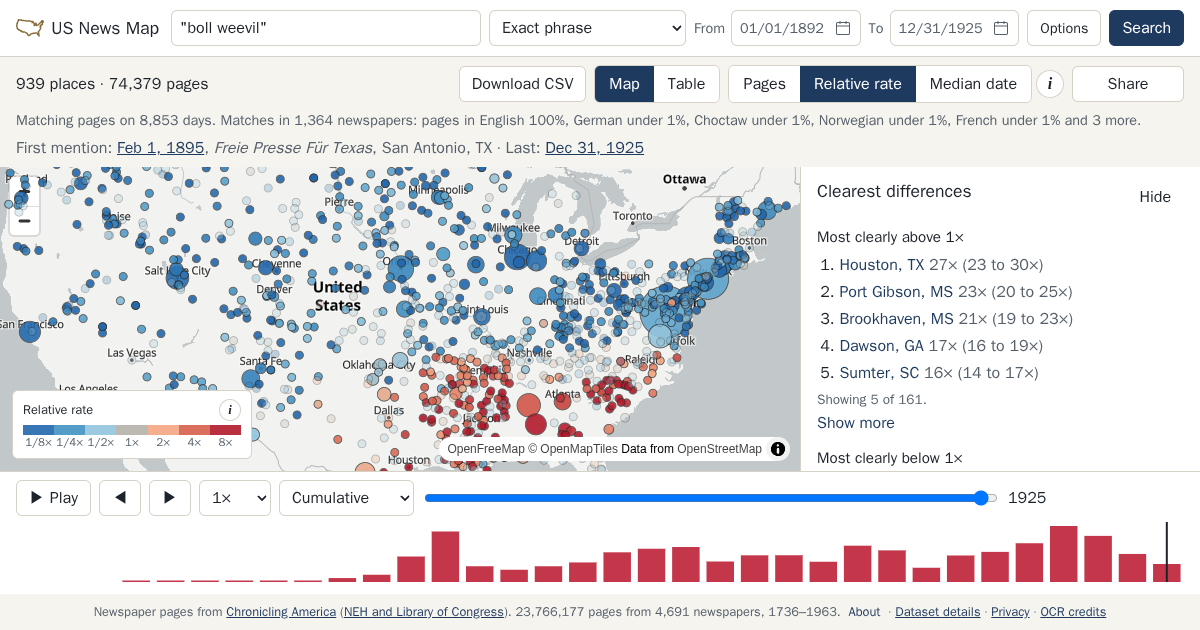
Boll weevil: Relative rate, 1892–1925
Relative rate compares local attention as the cotton pest spread across the South. Newspaper pages from 1892 to 1925 on a map and timeline.
US News Map searches Chronicling America, the Library of Congress collection of digitized American newspapers, and maps every matching page by where and when it was printed. Play the timeline to watch a word or a story move across the country.
Each result links to the full page image at the Library of Congress. US News Map is maintained by Trevor Goodyear.
23,766,177 pages from 4,691 newspapers, 1736–1963.
Sample results
74379 matching newspaper pages in total. Montgomery, AL has the most hits (6351 pages). Showing up to 10 earliest results from this city.
The Montgomery Advertiser — 1901-06-14, page 4
… rain has. made the growth of grass unusually rapid, and the scarcity of labor, together with large grain crops, makes it difficult and ex pensive to keep the fields in good condi tion. Injury from insects is light in most States, except for boll weevil in parts of Texas and lice in regions where moisture has been exceptionally heavy. These pests are not as harmful as usual, how ever, and aside from the probable in crease in cost, the planters have cause for gratifleatton. Reports from correspondents …
The Montgomery Advertiser — 1901-07-02, page 6
… ence here was an advance of 77T7V4 points at Liverpool. The bulls were encouraged by the special report of The Journal of Commerce showing the present crop con dition to be but 77 per cent, of perfect, as against *1.6 last month. Ravages by boll weevil, cut worms, sharpshooters and other Insects In the Southwest were said to be reaching alarming proportions. The South Atlantic States complained of fur ther soaking rains, scarcity of labor find a very backward condition. Near the close a …
The Montgomery Advertiser — 1901-10-02, page 1
… for the development of the top crop, and heavy rains have damaged the staple tn portion# of North Carolina. Georgia and Florida, while the Sea Island crop of South Carolina la suffering from drought. In Texas late cotton Is being damaged by boll weevil and other Insects, and the outlook of the top crop Is very poor. Only a small part of the tobacco crop and that In Kentucky and Tennessee, remains un housed. The reports generally indicate that this crop has been secured. In satis factory …
The Montgomery Advertiser — 1901-10-05, page 2
… misrloner Johns stated today that, In his opinion the Texas cotton Crop this year will fall short at least 800,000 hales from the < rop if last season. It Is es timated that the i rop of this year will not exceed t'.A'G.ouu bales, duo to the boll weevil and extensive drouth in parts of the State. Cascade Restaurant. The best the market affords served in first-class style. A1 Galatas, Prop., op posite The Advertiser office. adv. SUNDAY SCHOOL LESSON FOR TOMORROW ST I. & OtLMMMT, XJL , 4- ♦ …
The Montgomery Advertiser — 1902-01-22, page 4
… Both his parents arc dead, and he lives with an old grandmother more than SO years old. He has an uncle who Is one of the most famous physicians in North Carolina. I shall see that the lit tle fellow has a chance here In New York.” THE COTTON BOLL WEEVIL. Severe Cold in Winter is Rather” to Its Advantage Than Otherwise Galveston (Tex.) News. Of late there were numerous reports from various parts of the State to the effect that the recent cold Bpells had killed the greater tortion of the boll …
… successful hibernation of In sects, and that they hibernate either in the full grown etate or In the larvae of grub state, and that they pas* through very cold weather more securely than during mild spells alternating with cold spells. The cotton boll weevil le no ex ception to this rule, and while freezing weather kills this Insect in the late bolls of the ootton, the normal hibernation habits of the insect are by no means in terfered with by cold weather, no mat ter how severe it may be. The …
… cotton boll weevil hibernates in its full grown state and on approach of cold weather it instinctively seeks such Shelter as pro tects It throughout the winter. ^ During his stay at Victoria Mr. Schwarz has been In tM> Held every day and has lias urcu ns tiro …
The Montgomery Advertiser — 1902-04-25, page 6
… sufficiency of seed for partial replanting. Rain is needed In only a few' counties in West and Sodthwest Texas. Very little cot ton is held by farmers, though small lots are to be found in most of the producing counties. Only one county reports boll weevil, while others In the district expressly state that none of the weevil has appeared Out look for crop Is generally considered good for this time of the year." As predicted several days ago. It was on the «-ards for Liverpool to get very- bullish …
The Montgomery Advertiser — 1902-05-24, page 6
… been discounted. Every one looked for a bullish ”ln sight” statement, and for strong visible supply statement later In the day. Again private reports from the belt told cf good spot demand and some damage In parts of Ttgaa from cut worms and boll weevil. The Improvement, however, fa ted to enthuse com mission house buying and room traders took advantage of the higher prices to secure profits nn cotton purchased on the call. 8oon the whole list was easing off under scattering sales for a turn …
The Montgomery Advertiser — 1902-05-28, page 6
… 501.00 Excess of amount received by estate of insured over amount paid...$5.922.90 J. S. WILLCOX, Manager, Montgomery, Ala. MARKETS FOR FUTURES CABLES DISAPPOINTING AND CROP PROSPECTS FAVORABLE. Weekly Government Crop Report Shows Lice end Boll Weevil in Certain Sections of the Cotton Belt. NEW YORK. May 27.—'Th*’ cotton market opened fasy and unchanged to 3 paints lower under scattering sales by the room contingent and absence of liberal speculative support f cnn the commission house contingent …
… disamxdnf ing and the crop imports from private sources acre generally favorable. Immediately after the call the a hole market took a turn for the better on a small aeare of shorts and buying'for Kar -jesti accounts, started by claims thst boll weevil were Injuring the cotton plant In teat ions of the western belt. But this support soon fell «»fr to a straggling. Indifferent volume, the list slowly lost th» advance and later becemu weak In re. ponse to a decline in Liverpool and New Orleans …
The Montgomery Advertiser — 1902-05-28, page 9
… favorable conditions are reported from the Missouri and the Upper Mississippi Valleys <md in the lake re lions. But few adverse reports respecting cot ton are received. In portions of Texas. Oklahoma and Alabama the crop Is get ting grassy and boll weevil is Increasing and lice- appearing In Southern Texas. Generally throughout the cotton belt, however, fields are clean and the crop has wade good grow th and squares are form ing throughout the southern portion. Recent rains In the Ohio Valley …
The Montgomery Advertiser — 1902-06-01, page 1
… shift to other of ficers. Before the three officers can ac cept the decorations, which now repose In the State Department, Congress must pass a special act There may be a llvel? row In the House when the matter Is brought up. War on Cotton Boll Weevil Under the provision of the agricultural appropriation bill, which will receive the approval of the President within a few days, fcj'.aoo will be appropriated to prose cute the work of exterminating the cot ton-boll weevil. The work will begin in Texas, where the ravages of the Insect have been most harmful to cotton. Dr. L. O. Howard of the department Is con fident that great good will be accomplish ed by the appropriation. Alabamians Will Get Money. The President …
The interactive map and full results require JavaScript.