Abolitionists in newspapers, 1830–1860
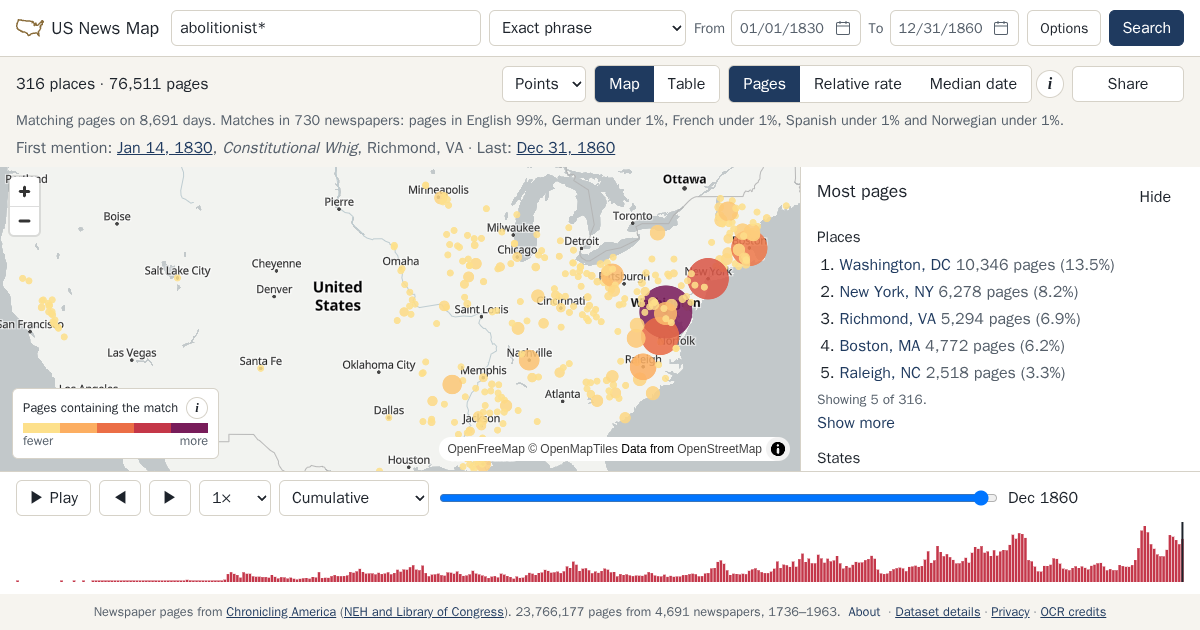
Mentions of the movement to end slavery, from 1830 to the eve of the Civil War. Newspaper pages from 1830 to 1860 on a map and timeline.
US News Map searches Chronicling America, the Library of Congress collection of digitized American newspapers, and maps every matching page by where and when it was printed. Play the timeline to watch a word or a story move across the country.
Each result links to the full page image at the Library of Congress. US News Map is maintained by Trevor Goodyear.
23,766,177 pages from 4,691 newspapers, 1736–1963.
Sample results
76511 matching newspaper pages in total. Washington, DC has the most hits (10346 pages). Showing up to 10 earliest results from this city.
Daily National Intelligencer — 1831-07-25, page 2
… seventy years hence, when dtir trade shall have been destroyed—our policy crum bled to ruins—our citizens ruined—and our spirits brok en down by wrongs upon wrongs heaped upon us, by a Government in the hands of manufacturers, fanatics, and abolitionists.” “Let the Legislature meet in the spring, and either de clare a separation from the Guion, or else declare the ob noxious laws a nullity, and forbid obedience to them, in conformity with the sentiments of the country, and ac cording to their …
Daily National Intelligencer — 1831-10-11, page 3
… without horror and dejection. For, who can congratulate himself upon a life passed without some act more mis chievous to the peace or prosperity of others than the theft of a piece of money I— Sani. Johnson. FROM TUB AMERICAN BRBCTATOU. Sl wery Abolitionists.—This distinctive ap pellation is become altogether indispensable to denote those, both in Europe and America, who would abolish slavery at once,without taking con sequences into the account; who would tear asun der the bonds of the captive …
… the general title of the friends of anti-sla very. If they will not assume a distinctive title, justice requires that one should be given them and nothing can be more just to their designs, or truer to their sentiments, than to call them the Abolitionists of Slavery, a name by which they have been already distinguished. An Abolitionist in England, of the name of Stuart, has extended the sphere of his raving to this country, and has published a tirade against the Colonization Society People of ■Great Britain, it is your business—it is your duty —to give negro slavery no rest …
… place, the States con cerned would not submit to the exercise of such a power. Inthe third place, precedent, even were there nothing else, has legally vested the power of legislation, on the subject of slavery, in the seve ral States; and the abolitionists can actually effect nothing, in this country, beyond a mere moral in fluence, and that influence decidedly injurious both to slaves and freedmen, till they can per suade the Legislatures of individual States to abo lish slavery within their …
Daily National Intelligencer — 1832-04-14, page 3
… Lynchburg Virginian states, upon rumor, that Mr. Randolph (John) declined.in consequence of bad health, standing for the county of Charlotte, on the morning of the election, and that Mr. Richardson, the late member, was re-chosen. The Anti-Abolitionists will be disappoint ed. Mr. Randolph’s talents were considered essential to support their cause.— Whig. |Ture Register.—The Turf Register for April has made its appearance. Il is in the usual style, containing an abundance of matter calculated …
Daily National Intelligencer — 1833-05-07, page 3
… change of principles or modification in the opinions of the Government. London, Aphid I.—Lord Howick has resigned his place at the Colonial Office, not without the satisfaction of the West India body, nor entirely to the displeasure of the Abolitionists. He is succeeded by Mr. Lefevre, late member for Petersfield. FRANCE. The Indicateur of Bordeaux of the 27th March states that the health of the Duchess of Berri has been im proving for the last few days whilst the Journal de la Guienne, the …
Daily National Intelligencer — 1833-06-15, page 3
… becoming to me a for eign country. You know, that 1 have regarded my rank of an American Citizen as a prouder birthright than that of the haughtiest noble ofEurope, whose lineage is lost in the darkness of antiquity. But sooner than suffer the Abolitionists to carry into execution their plans, I too would go for a dissolution of this Union. I be lieve before God! that Justice and Humanity to slave as well as to master, would require of me to do so. This is not a fitting occasion, neither is it …
… delicate a relation as that of master and slave; nor to expatiate on the unwarrantable interference with the rights of others, nor on the violation of faith solemnly pledged even in the Constitution of our Liberties, as is purposed by the Abolitionists. In portraying the dreadfui consequences to master, and still more to the slave, with the vices, crimes, bloodshed and horrors that would follow imme diate abolition, who could fail to be eloquent? But im mediate abolition is an event quite …
… out of the question, and one of the certain consequences of any movement, either on the part of the slaves or of the Abolitionists, is the riveting with tenfold severity of the chains of the former. This any one may easily perceive, by examin ing the enactments on this subject, made since the distri. bution of Walker’s pamphlet, and the Virginia insur rection. Do not …
Daily National Intelligencer — 1833-06-21, page 2
… attempted again to speak, and asked permission for that purpose from the Chair. The Chair stated that the meet ing was called by the friends of colonization, and that its opponents were not invited, and could not be heard. Af ter this, the colored abolitionists at the door frequently hissed the resolution and remarks.] Mr. Finley, Agent of the Society, introduced to the meeting Mr. George Washington Davis, a colored citizen of Liberia, and a native of Virginia. Mr. Davis addressed tire meeting at …
Daily National Intelligencer — 1833-06-25, page 3
… State, and the State of South Carolina. He spoke of slavery with much feeling and philanthro py, and remarked, that strange as it might seem for him, coming* from a slave S tate,he would call upon his Maker to witness that the most violent abolitionist of the North could not more seriously desire the dissolution of the ties between the master and the slave than himself. Se veral circumstances were now concurring to hasten that result a change had taken place even within a year, in the sentiments …
Daily National Intelligencer — 1833-09-28, page 2
… Citizen of Fauquier is welcome to guess as much as he pleases, about me but, I do assure him that, although I have held some slaves, and might have had more, I never sold one in my life. And, 1 would not have him to suppose me to be a Garrison abolitionist. I would rejoice, indeed, to see the whole of the colored popula tion sent clear away from the United States—for, if they are not colonized, they will colonize their owners in less than a century—but, if we must have such a host among us, …
Daily National Intelligencer — 1833-10-03, page 3
… are, that the slaves are in a better condition than they would be if they were suffered to remain in this country and that both castes, in the proportion they exist in the Southern States, could not live together in a state of freedom. The abolitionists demand, that the entire value of the property invested in slaves, shall be immediately sunk to the owners. And when is this demand made After the slave holders have borne on the principle of representation, their proportion of the debt incurred …
… , with the aid of their countrymen on the contiguous islands, should gain possession of the Northern confederacy. “But suppose I am too much’ alarmed—is there not some good reason to apprehend the experiment will not succeed as well as the abolitionists anticipate Will it not be prudent for us to wait, and see what the result will be, if the experiment shall be tried in the British West India Islands I Is the British Government eager to enlighten the ignorant—to do justice, and to relieve …
Daily National Intelligencer — 1833-10-07, page 2
… until after the publica tion of jur paper last evening, of the extent and depth of the excitement prevailing amongst our citizens, in regard to the meeting called by a few individuals, for the purpose of organizing a So ciety of immediate abolitionists. It appears, how ever, that our most respectable citizens, with one voice, were grieved that such a meeting should have been called in New York, and many of them had determined to attend, and assist in crushing the dangerous project. A still …
The interactive map and full results require JavaScript.